

Clive Cussler
- ISBN 13 : 9780593087930
- Judul : Clive Cussler
- Pengarang : Clive Cussler,
- Penerbit : G.P. Putnam’s Sons
- DDC : Novel
- Bahasa : Indonesia
- Tahun : 2025
- Halaman : 479
-
Ketersediaan :
016543 Tersedia di Library of UI BBC
| 016543 |
Tersedia di Library of UI BBC
|


| 015395 |
Tersedia di Library of UI BBC
|

Sumarna, dkk (2019 : 120) mengemukakan pendapatnya tentang Perbankan bahwa bank adalah badan usaha yang menghimpun dana dari masyarakat dalam bentuk simpanan dan menyalurkannya kepada masyarakat dalam bentuk kredit atau dalam bentuk layanan lainnya dalam rangka meningkatkan taraf hidup rakyat banyak. Lembaga keuangan ini memberikan fasilitas bagi pihak yang memiliki dana lebih dan pihak yang memiliki dana yang kurang, mempermudah transaksi pembayaran, dan mencari keuntungan. Menurut Yulisari, dkk (2021 : 31), bank ialah sebuah lembaga keuangan yang memiliki fungsi sebagai penyimpan dan penyalur dana bagi masyarakat yang membutuhkan. Sementara itu, Sesiady, dkk (2018 : 182), bank merupakan penyedia bermacam layanan financial yang salah satunya adalah layanan penyaluran kredit modal kerja. Dari beberapa definisi mengenai bank di atas, disimpulkan bahwa bank merupakan suatu lembaga keuangan yang bergerak menyediakan fasilitas simpan pinjam yang diperuntukkan mensejahterakan perekonomian rakyat
Menurut Yulisari, dkk (2021 : 31), bank ialah sebuah lembaga keuangan yang memiliki fungsi sebagai penyimpan dan penyalur dana bagi masyarakat yang membutuhkan.
This edited book is a comparative study on teacher education across ten major English-speaking regions of the world (USA, English Canada, England and Wales, Scotland, Ireland, Singapore, Hong Kong, South Africa, Australia, New Zealand). The focus on individual regions is reflective of a comparative approach with a long tradition going back to the turn of the twentieth century. Each of the chapters focuses on general trends in teacher education rather than on any specific aspect of it; focuses primarily on pre-service teacher education at the primary and post-primary levels, although some reference is also made to continuing professional development; strikes a balance between past, present and future trends; deals broadly with access to, the processes involved in, and the structure of, teacher education; has a unique structure rather than one based upon a formulaic approach. In the final chapter major themes are distilled from the case studies. It also outlines how the book furthers understanding of teacher education internationally, considers other groupings of regions ripe for consideration along similar lines, and indicates initiatives arising out of the case studies worthy of consideration for the improvement of teacher education cross-nationally. {Back cover, ed].
This edited book is a comparative study on teacher education across ten major English-speaking regions of the world (USA, English Canada, England and Wales, Scotland, Ireland, Singapore, Hong Kong, South Africa, Australia, New Zealand).

With this in-depth, easy-to-use tool, your program can reliably assess and monitor social-emotional development in infants, toddlers, and preschoolers at risk for delays or challenges. An ideal followup to screeners such as ASQ:SE, the two-part SEAM(tm) assessment reveals detailed qualitative information on childrenâe(tm)s social-emotional competence-- and identifies their caregiversâe(tm) strengths and areas of need. Easy to learn and implement, SEAM can be used by a wide variety of early childhood professionals, including those with little or no training in mental-health or behavioral interventions. SEAM helps your program: support development of important social-emotional skills in order to minimize challenging behaviors build strong, proactive partnerships with families promote positive parentâe"child interactions in the critical first years of life assist with developing developmentally appropriate goals and intervention activities monitor child progress toward social-emotional goals SEAM is a two-part assessment; All forms are available in English and Spanish on the CD-ROM or e-book. SEAM Tool The main SEAM includes three intervals with different developmental ranges: Infant (2-18 months), Toddler (18-36 months), and Preschool (36-66 months). Each interval assesses 10 child benchmarks critical to social-emotional competence, including empathy, adaptive skills, self-image, emotional responses, and healthy interactions with others. SEAM is flexible enough to meet your specific needs--parents/caregivers can complete it independently, or you can conduct it jointly with them if they need extra guidance. The SEAM system also includes SEAM with Ages, an alternate version of the tool annotated with a helpful list of age ranges for each item. This version makes it easy to give caregivers general guidance on how social-emotional skills typically develop and where their childâe(tm)s development fits on the continuum. SEAM Family Profile The Family Profile assesses parent and caregiver strengths and helps identify areas in which they need more supports and resources to foster their childâe(tm)s social-emotional skills. Like the main SEAM, the Family Profile assessment includes three intervals--Infant, Toddler, and Preschool. Each interval measures four benchmarks key to a nurturing home environment: responding to needs, providing activities and play, providing predictable routines and an appropriate environment, and ensuring home safety. List of SEAM benchmarks Child participates in healthy interactions Child expresses a range of emotions Child regulates social-emotional responses Child begins to show empathy for others Child attends to and engages with others Child explores hands and feet and surroundings (for infants)/demonstrates independence (for toddlers/preschoolers) Child displays a positive self-image Child regulates activity level Child cooperates with daily routines and requests Child shows a range of adaptive skills View the webinar recording of Using the Social-Emotional Assessment/Evaluation Measure (SEAM(tm)) with Young Children, presented by Jane Squires, Ph.D., and Misti Waddell, M.S. See which domain of school readiness in the Head Start Child Development and Early Learning Framework this tool addresses.
List of SEAM benchmarks Child participates in healthy interactions Child expresses a range of emotions Child regulates social-emotional responses Child begins to show empathy for others Child attends to and engages with others Child ...
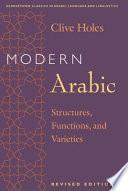
The revised and updated edition of Modern Arabic takes this authoritative, concise linguistic description of the structure and use of modern Arabic to an invaluable new level. Clive Holes traces the development of the Arabic language from Classical Arabic, the written language used in the 7th century for the Qur'an and poetry, through the increasingly symbiotic use of Modern Standard Arabic or MSA (the language of writing and formal speech) and dialectal Arabic (the language of normal conversation). He shows how Arabic has been shaped over the centuries by migration, urbanization, and education--giving us "a balanced, dispassionate, and accurate picture of the structures, functions, and varieties of the contemporary Arabic language." Holes explains the structural characteristics--phonology, morphology, syntax, semantics, and lexical and stylistic developments--that the majority of the dialects share, as distinguished from Modern Standard Arabic. He also shows how native speakers use both types of Arabic for different purposes, with MSA being the language of power and control as used on television and in political speeches, and the dialects serving as the language of intimacy and domesticity. He further shows how MSA and spoken dialects are not as compartmentalized as one might be led to believe. Modern Arabic illustrates the use of the Arabic language in real life, whether in conversation, news bulletins and newspaper articles, serious literature, or song. This new edition takes into account research published in several areas of Arabic linguistics since the first edition was published in 1995. It includes more extensive comment on the North African Arabic vocabulary of Modern Standard Arabic, more information about "mixed" varieties of written Arabic that are not in MSA (especially in Egypt), updated references, explanations, and many new examples. All Arabic is transcribed, except for an appendix presenting the Arabic alphabet and script. Students of the Arabic language will find Modern Arabic without peer--as will those general linguists who are interested in discovering how Arabic compares structurally and sociolinguistically with European languages.
This new edition takes into account research published in several areas of Arabic linguistics since the first edition was published in 1995.
... which they cannot be made personally and individually answerable to the laws and tribunals of any foreign country . ... of the rule that an act done animo bellegerendi cannot constitute the basis of criminal or civil proceedings .

This innovative text offers an introduction to money, banking, and financial markets, with a special emphasis on the importance of confidence and trust in the macroeconomic system. It also presents the theory of endogenous money creation, in contrast to the standard money multiplier and fractional reserve explanation found in other textbooks. The U.S. economy and financial institutions are used to explain the theoretical and practical framework, with international examples weaved in throughout the text. It covers key topics including monetary policy, fiscal policy, accounting principles, credit creation, central banks, and government treasuries. Additionally, the book considers the international economy, including exchange rates, the Eurozone, Chinese monetary policy, and reserve currencies. Taking a broad look at the financial system, it also looks at banking regulation, cryptocurrencies, real estate, and the oil and gold commodity markets. Students are supported with chapter objectives, key terms, and problems. A test bank is available for instructors. This is an accessible introductory textbook for courses on money and banking, macroeconomics, monetary policy, and financial markets.
The U.S. Treasury Department is not an independent entity by any means—it is owned by the American citizens. Created by an act of Congress in 1798, it is the department of the U.S. government that is responsible for managing the ...