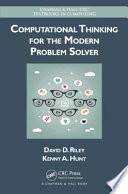
Through examples and analogies, Computational Thinking for the Modern Problem Solver introduces computational thinking as part of an introductory computing course and shows how computer science concepts are applicable to other fields. It keeps the material accessible and relevant to noncomputer science majors. With numerous color figures, this classroom-tested book focuses on both foundational computer science concepts and engineering topics. It covers abstraction, algorithms, logic, graph theory, social issues of software, and numeric modeling as well as execution control, problem-solving strategies, testing, and data encoding and organizing. The text also discusses fundamental concepts of programming, including variables and assignment, sequential execution, selection, repetition, control abstraction, data organization, and concurrency. The authors present the algorithms using language-independent notation.
It keeps the material accessible and relevant to noncomputer science majors. With numerous color figures, this classroom-tested book focuses on both foundational computer science concepts and engineering topics.
This book covers studies of computational thinking related to linking, infusing, and embedding computational thinking elements to school curricula, teacher education and STEM related subjects. Presenting the distinguished and exemplary works by educators and researchers in the field highlighting the contemporary trends and issues, creative and unique approaches, innovative methods, frameworks, pedagogies and theoretical and practical aspects in computational thinking. A decade ago the notion of computational thinking was introduced by Jeannette Wing and envisioned that computational thinking will be a fundamental skill that complements to reading, writing and arithmetic for everyone and represents a universally applicable attitude. The computational thinking is considered a thought processes involved in a way of solving problems, designing systems, and understanding human behaviour. Assimilating computational thinking at young age will assist them to enhance problem solving skills, improve logical reasoning, and advance analytical ability - key attributes to succeed in the 21st century. Educators around the world are investing their relentless effort in equipping the young generation with real-world skills ready for the demand and challenges of the future. It is commonly believed that computational thinking will play a pivotal and dominant role in this endeavour. Wide-ranging research on and application of computational thinking in education have been emerged in the last ten years. This book will document attempts to conduct systematic, prodigious and multidisciplinary research in computational thinking and present their findings and accomplishments.
This book covers studies of computational thinking related to linking, infusing, and embedding computational thinking elements to school curricula, teacher education and STEM related subjects.
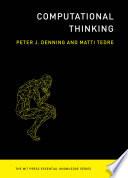
This pocket-sized introduction to computational thinking and problem-solving traces its genealogy centuries before the digital computer. A few decades into the digital era, scientists discovered that thinking in terms of computation made possible an entirely new way of organizing scientific investigation. Eventually, every field had a computational branch: computational physics, computational biology, computational sociology. More recently, “computational thinking” has become part of the K–12 curriculum. But what is computational thinking? This volume in the MIT Press Essential Knowledge series offers an accessible overview—tracing a genealogy that begins centuries before digital computers and portraying computational thinking as the pioneers of computing have described it. The authors explain that computational thinking (CT) is not a set of concepts for programming; it is a way of thinking that is honed through practice: the mental skills for designing computations to do jobs for us, and for explaining and interpreting the world as a complex of information processes. Mathematically trained experts (known as “computers”) who performed complex calculations as teams engaged in CT long before electronic computers. In each chapter, the author identify different dimensions of today's highly developed CT: • Computational Methods • Computing Machines • Computing Education • Software Engineering • Computational Science • Design Along the way, they debunk inflated claims for CT and computation while making clear the power of CT in all its complexity and multiplicity.
This volume in the MIT Press Essential Knowledge series offers an accessible overview—tracing a genealogy that begins centuries before digital computers and portraying computational thinking as the pioneers of computing have described it.
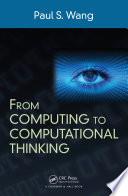
Computational Thinking (CT) involves fundamental concepts and reasoning, distilled from computer science and other computational sciences, which become powerful general mental tools for solving problems, increasing efficiency, reducing complexity, designing procedures, or interacting with humans and machines. An easy-to-understand guidebook, From Computing to Computational Thinking gives you the tools for understanding and using CT. It does not assume experience or knowledge of programming or of a programming language, but explains concepts and methods for CT with clarity and depth. Successful applications in diverse disciplines have shown the power of CT in problem solving. The book uses puzzles, games, and everyday examples as starting points for discussion and for connecting abstract thinking patterns to real-life situations. It provides an interesting and thought-provoking way to gain general knowledge about modern computing and the concepts and thinking processes underlying modern digital technologies.
The book uses puzzles, games, and everyday examples as starting points for discussion and for connecting abstract thinking patterns to real-life situations.
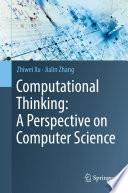
This textbook is intended as a textbook for one-semester, introductory computer science courses aimed at undergraduate students from all disciplines. Self-contained and with no prerequisites, it focuses on elementary knowledge and thinking models. The content has been tested in university classrooms for over six years, and has been used in summer schools to train university and high-school teachers on teaching introductory computer science courses using computational thinking. This book introduces computer science from a computational thinking perspective. In computer science the way of thinking is characterized by three external and eight internal features, including automatic execution, bit-accuracy and abstraction. The book is divided into chapters on logic thinking, algorithmic thinking, systems thinking, and network thinking. It also covers societal impact and responsible computing material – from ICT industry to digital economy, from the wonder of exponentiation to wonder of cyberspace, and from code of conduct to best practices for independent work. The book’s structure encourages active, hands-on learning using the pedagogic tool Bloom's taxonomy to create computational solutions to over 200 problems of varying difficulty. Students solve problems using a combination of thought experiment, programming, and written methods. Only 300 lines of code in total are required to solve most programming problems in this book.